SEO as you knew it's dead.
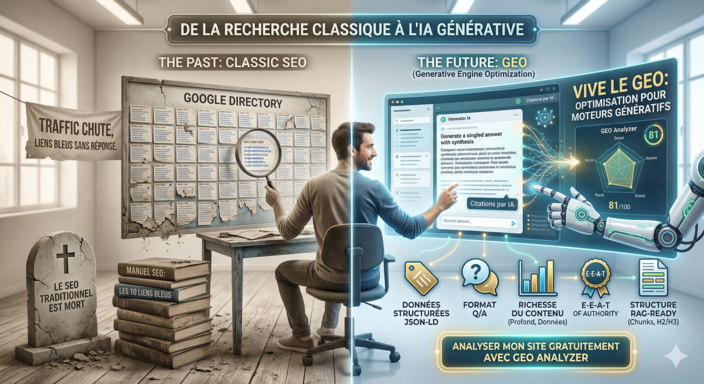
Since the arrival of generative AI, thousands of sites have been losing traffic without understanding why. It’s not because their SEO is bad—it’s because artificial intelligence simply doesn't "see" them.
Traffic is falling. And no one really understands why.
Imagine this: You’ve spent months optimizing your site. Polished meta tags, well-placed keywords, hard-won backlinks. Google is smiling on you. Your rankings are solid. And then, gradually, your metrics start to dip. Not suddenly. Insidiously. Like a slow hemorrhage.
This is the scenario hundreds of webmasters and businesses are facing right now. And most are looking for the cause in the wrong place: in their tags, their links, or their code.
The real cause? It’s not on their site. It’s in the way people search for information—and that way has changed radically.
In 2026, a growing share of searches no longer ends with a click on a Google link. It ends with a direct answer generated by an AI: ChatGPT, Gemini, Perplexity, Claude... These systems don’t show ten blue links. They answer. And to provide that answer, they cite sources. Perhaps not yours.
Google is a directory. Gemini is an expert. They are not the same thing.
To understand why your SEO is no longer enough, you first need to grasp the fundamental difference between a traditional search engine and a generative AI.
Google is a massive directory. You ask a question, and it shows you a list of pages that might answer it. You click, you read, and you find (or don't find) the answer. The job of SEO is to place you at the top of that directory.
Gemini, ChatGPT, or Perplexity is an expert who answers you directly. You ask a question, and it synthesizes the response from dozens of sources it has read and understood. It occasionally cites its sources—like a journalist mentioning their interviewees. You no longer need to click through ten links to find what you need.
This shift changes everything. The goal remains the same—to be found, read, and chosen. But the mechanism is radically different. And so are the rules of the game.
Being on page one of Google no longer guarantees being cited by an AI. A page that ranks well but is poorly structured for an AI can exist perfectly in Google's eyes while remaining totally invisible to ChatGPT or Gemini. This is exactly what is happening to thousands of sites right now.
Why I built a tool to "see" like an AI
A few months ago, I asked myself a simple question: What does an artificial intelligence actually see when it analyzes a web page?
I looked for existing tools. In English, there were a few attempts. In French, almost nothing serious. Nothing that truly explained, criterion by criterion, why one page would be cited by an AI and another wouldn't.
So, I built the tool myself.
The GEO Analyzer scans any URL in seconds and evaluates 22 criteria across three major categories: semantics (is the content understandable for an AI?), authority (can the AI trust you?), and technical (is the page physically readable for a bot?). It generates a score, a visual radar chart, and concrete recommendations generated by an AI.
What I discovered while analyzing dozens of pages sometimes surprised me. Sites that were technically perfect for Google were catastrophic for an AI. Modest blogs were perfectly "readable" by ChatGPT and Perplexity. The correlation between traditional SEO and GEO visibility is much weaker than one might think.
The 5 GEO criteria that truly make a difference
Among the 22 criteria analyzed by the tool, five consistently emerge as the most significant differentiators between pages that are cited and pages that are ignored by AI. Here they are, explained without the jargon.
1. JSON-LD Structured Data: Speaking directly to the AI
Imagine if you could slip a small ID card into your page—invisible to human visitors, but perfectly readable for an AI. That’s exactly what structured data in JSON-LD format does.
It tells the artificial intelligence: "This page is an article, it was written by Fabrice Faucheux, it discusses SEO and GEO, and it was published on March 27, 2026." Without this data, the AI has to guess. And when it guesses, it sometimes gets it wrong—or worse, it prefers another source that took the trouble to introduce itself correctly.
Audit results show that over 60% of analyzed sites have no structured data. This is a massive opportunity for those who seize it.
2. Question/Answer format in headings
Generative AIs are trained to answer questions. It is therefore logical that they prioritize pages organized in a Q&A format. A heading like "How to optimize your site for AI in 2026?" is infinitely more "citable" by an AI than a heading like "Advanced optimization for generative engines."
This isn't just about SEO. It’s about format. The AI wants to find an answer. Give it a page that looks like an answer.
3. Content Richness: AI doesn't cite empty pages
An AI model works through extraction and synthesis. It needs material to work with. A 200-word page simply doesn't offer enough substance to be a reliable source.
The most cited pages in my analyses consistently exceed 800 words, filled with concrete facts, figures, and examples. Not filler—informational density. Every paragraph must provide something that the AI can extract and cite.
4. E-E-A-T Authority: Who are you in the eyes of a machine?
E-E-A-T stands for Experience, Expertise, Authoritativeness, and Trustworthiness. This concept was introduced by Google, but generative AIs have fully integrated it. They look for reliable sources written by identifiable experts in fields where they have recognized legitimacy.
In practical terms: Is your author name visible? Is your organization declared in your structured data? Is your domain cited by other recognized sources? These signals might seem anecdotal, but they are actually decisive in whether an AI chooses you as a source over a competitor.
5. RAG-ready structure: How the AI "slices" your text
Modern AIs use a technique called RAG—Retrieval-Augmented Generation. To put it simply: they slice web pages into pieces ("chunks"), and when they answer a question, they retrieve the most relevant pieces to assemble their response.
If your page is a compact block of text without subheadings, the AI will struggle to slice it cleanly. It risks missing your most valuable information. Conversely, a well-paced page with clear H2 and H3 tags, short paragraphs, and bullet points is a dream for a RAG engine.
Practical rule: Never more than 4 to 5 paragraphs between two subheadings. Your text needs to breathe—for your human readers, and for the machines that read it too.
A concrete example: What an AI sees on a real page
To illustrate the difference, I analyzed two types of pages with the GEO Analyzer. The names have been anonymized, but the results are real.
Page A — A local service provider: Well-ranked on Google, first page for several local queries. GEO Score: 38/100. No structured data, no questions in headings, 180 words of content, no author tag, and a single image without alt text. For an AI, this page is virtually non-existent.
Page B — An independent blog with low Google traffic: GEO Score: 81/100. FAQ structured with schema, interrogative headings, 1,200 words with data points, identified author, and outbound links to recognized sources. For Perplexity or ChatGPT, this page is a prime source.
The result? Page B is regularly cited by generative AIs on its topic. Page A, despite its Google visibility, never appears in AI answers.
This is the new digital divide. It’s not between the big and the small—it’s between those who have understood the new rules and those who still ignore them.
What GEO does not replace
Let’s be honest. Traditional SEO isn't 100% dead. To claim otherwise would be an exaggeration and would mislead you.
Quality backlinks still play a role—largely because AIs themselves learn from the web ecosystem, where domain authority remains a strong signal. Loading speed is still important for user experience. Quality content is, and will always be, the foundation of everything.
What has changed is that these elements are no longer enough on their own. SEO and GEO are not in opposition—they are complementary. One makes you visible to humans searching via Google. The other makes you citable for AIs synthesizing answers.
Neglecting one in favor of the other would be a mistake. The true visibility strategy in 2026 is both working together.
And now? Knowing where you stand.
The first step is to understand how your site is perceived today by an artificial intelligence. Not how you think it's perceived—how it actually is.
I built a free tool that performs this analysis in less than 30 seconds. You enter your URL, it evaluates 22 GEO criteria, generates a score, identifies your weak points, and provides concrete recommendations generated by an AI.
No account to create. No credit card required. Just your URL and the truth about what an AI sees on your site.
Frequently Asked Questions
Is SEO really dead in 2026?
-
No, traditional SEO is not totally dead, but it is no longer sufficient on its own. Backlinks, loading speed, and quality content remain important. What has changed is that generative AIs add a new layer of visibility—and to exist there, you must adopt the rules of GEO.
What is GEO (Generative Engine Optimization)?
-
GEO is the set of practices that allow your content to be selected and cited by generative AIs (ChatGPT, Perplexity, Google AI Overviews...) when they answer user questions. It complements SEO without replacing it.
How do I know if my site is visible to AI?
-
You can use a GEO audit tool like the one I developed at faucheux.bzh. It analyzes your page in 30 seconds and gives you a score across 22 key criteria: structured data, AI readability, E-E-A-T authority, RAG-ready structure, and many others.
What is the difference between Google and a generative AI?
-
Google is a directory that ranks links. A generative AI like ChatGPT or Perplexity is an expert that synthesizes answers by citing sources. The goal remains the same—to be found—but the mechanism is radically different.
Is GEO accessible to small businesses?
-
Absolutely. Unlike SEO, which often favors large netlinking budgets, GEO primarily rewards the quality and clarity of content. An SMB with well-structured, precise, and data-rich content can outshine a major brand in the eyes of an AI.
Discover my AI tools
Explore the Gemotheque, generate optimized prompts for ChatGPT and Midjourney, or test my dedicated AI assistants.